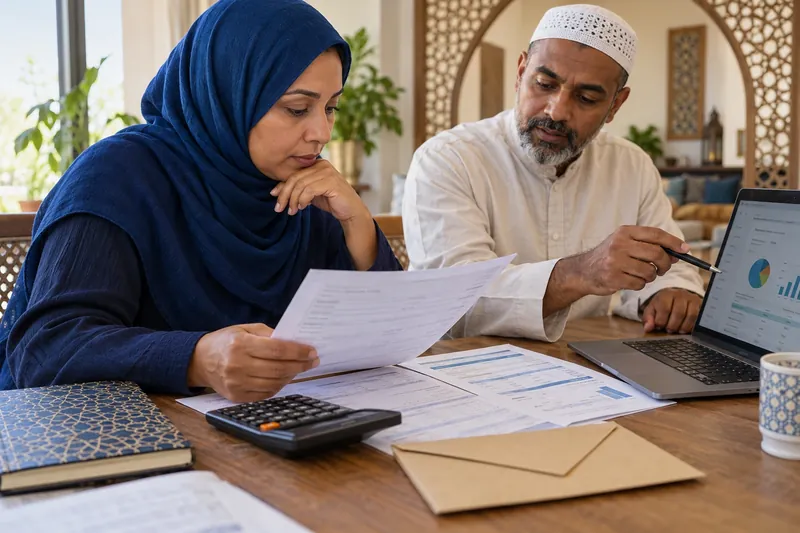
An islamic loan without credit check is a phrase that appeals to people with a thin file, an old default or a mistake on their record, but it needs a sober look. Regulated Islamic banks and finance companies generally assess applicants in some way, because they must judge whether a customer can pay, and the label halal does not switch off that duty.
What differs is how the assessment is done and what happens when the result is poor. Some providers use softer checks, some rely on a deposit or a guarantor, and some charities skip credit scoring entirely but offer only small sums. The sections below separate what is realistic from what is a trap.
What a credit check actually does
A credit check retrieves the history held by one or more credit reference agencies: past loans, repayments, defaults, court judgments and the number of recent applications. Lenders use it with income and expense details to decide whether to lend and on what terms.
Two types of check exist. A soft search lets an organisation view limited information without leaving a visible mark that other lenders can see, often used for quotations. A hard search is recorded and may count against the applicant if several appear in a short period. Knowing which one a provider is using helps a person to apply without damaging a file further.
Nothing in the Islamic rules on contracts forbids a seller from inquiring into a buyer's ability to pay. Scholars tend to treat reasonable inquiry as prudent, since deferred-payment sales create a debt and the seller is entitled to know the buyer's circumstances. The questions that remain concern fairness and accuracy, not whether checking itself is permitted.
Why an islamic loan without credit check is rare
Offers that skip every check tend to rest on something else that protects the provider: a large deposit, security over an asset, a high price or a short term. Each shifts risk back to the customer, sometimes sharply.
In an Islamic purchase contract the bank or company buys an asset and sells it on at a higher disclosed price payable later. If the buyer defaults, the provider may suffer a loss that interest-based lenders would cover with penalty interest. Because Islamic rules restrict late charges that benefit the provider, the safest course for the provider is to avoid lending to people unlikely to pay.
The phrase no check is therefore a marketing claim in many cases. The check may be hidden within an affordability assessment, a bank statement review or a requirement for payroll deduction. Read the application to see what is really being examined.
Anyone who is promised approval before any information is given should assume the offer will be costly or fraudulent.
No credit check Islamic finance: what to verify
If you meet a provider advertising no credit check Islamic finance, verify it before sharing documents. Look for a registered business name, a physical address, a regulator's registration where the law requires one and a written contract that names the goods and shows the price.
Then test the structure:
- Does the provider own the item before selling it to you?
- Is the total price stated up front and fixed, with no charge that rises with time?
- Are late-payment terms written, and where would any late-payment money go?
- Is there a Sharia supervisory board whose ruling you can read?
- Can you settle early and what rebate, if any, applies?
Never pay a fee before a loan is released. A genuine provider takes its costs from the contract, not from an upfront payment to an intermediary who promises approval.
Finally, keep every document. If a dispute arises, a signed contract and dated messages are your protection.
Bad credit Islamic finance and its limits
Bad credit Islamic finance exists in a limited form. Some providers accept applicants with minor blemishes if income is steady, others ask for a larger deposit or a guarantor, and some specialise in small purchases such as appliances or vehicles where the item itself serves as security under the contract.
Expect conditions on any islamic loan without credit check to be tougher. Prices may be higher to reflect risk, terms may be shorter and the range of goods narrower. Be sceptical of profit rates that look far above the market for similar goods, since the Islamic permission to sell at a mark-up is not a licence to charge any amount.
A person with bad credit may do better to improve the file first. Check the credit report for errors, register on the electoral roll where that applies, settle small defaults and avoid several applications in a row. Free debt advice can help prepare for a future application.
If a refusal comes, ask which reason led to it. Lenders in many countries must tell an applicant if a credit file played a part, which allows the person to correct mistakes.
Interest-free alternatives that skip scoring
Some sources of help do not rely on credit scores at all. Charity-run qard hasan funds lend small sums interest-free to people in hardship, and assessments focus on need and a plan for repayment rather than a score. Mosques and community groups may run similar schemes informally.
Family and friends are another source. An interest-free loan between relatives needs no credit file, but it should be written down with amounts and dates, ideally with a witness, as Islamic tradition recommends for debts. Clear records prevent hurt feelings later.
Grants are a separate category. For essential costs, a charity may give zakat funds to those who qualify, and no repayment follows. Applicants must supply honest information, and the charity decides on the basis of its own criteria and scholars' guidance.
These routes are limited in size, and none is a way to finance a car or a house. They suit emergencies and small gaps where an islamic loan without credit check would otherwise tempt a person toward a costly product.
Contracts that may appear and what each means
If an offer is presented as an islamic loan without credit check, identify which contract it really uses.
Murabaha is a sale of goods at cost plus a disclosed profit, with payment deferred. Ijara is a lease in which the provider keeps ownership and the customer pays rent, sometimes ending in ownership. Tawarruq involves buying a commodity on deferred terms and selling it to a third party for cash, and scholars disagree on whether organised forms are acceptable. Qard hasan is a loan repaid at the same amount, with nothing added.
Each contract carries different risks. Under a lease, missed rent can lead to repossession, while under a deferred sale the debt is owed even if the goods lose value. Under tawarruq, the cash received may be lower than the debt created, so read the figures carefully.
Ask the provider to show, in the contract, which of these applies. A scholar who is not tied to the provider can explain whether the structure matches the label.
Protecting your credit file while you look
Shopping around can hurt a file if every inquiry is a hard search. Ask for a quotation or eligibility check that uses a soft search, and apply to a small number of providers rather than many.
Anyone seeking an islamic loan without credit check should keep records of what they share. Send documents through the provider's secure channel and avoid emailing photographs of identity papers to unknown addresses. Fraudsters posing as Islamic lenders collect these items for identity theft.
If a provider seems to be pressuring you, pause. Real lenders do not penalise someone for taking a day to read a contract. Before signing, check the full repayment schedule against your budget and leave a margin for the unexpected.
Where a loan is still needed after all this, a conventional-free option might include saving through a halal savings scheme for the purchase, buying a cheaper model or asking the community. Delaying can be a better choice than agreeing to an unaffordable contract.
Crowdfunding for a specific need
When the need is a single cost that cannot wait and credit is out of reach, a community appeal may fill the gap. A crowdfunding page presents the situation and amount, and supporters give as sadaqah without any credit assessment. It carries no repayment, which is its advantage and its limit: results depend on the story, the network and the trust the organiser has built.
Be careful with wording. If anyone gives money as a loan, repayment terms must be agreed and written, and the lender may take back only what was lent. If money is given as a gift, it should not be later demanded back.
Honest documentation is the key. Invoices, quotations and a verifying letter from a mosque or charity help donors decide.
An islamic loan without credit check may feel like the faster path, but a transparent appeal or a charity grant usually costs less and leaves no hidden debt.
Organisations offering this service
- Al Rayan Bank — A UK Sharia-compliant bank established in 2004 that specialises in structured real estate and premier banking.
- Kuwait Finance House — Kuwait's first Islamic bank, founded in 1977, offering accounts, cards and Shariah-compliant home and consumer financing.
Related pages
- Islamic funding for personal needs: loans and campaigns
- Islamic Crowdfunding for Patients Medical Expenses: Checks
- Islamic Crowdfunding for Registered Charities Organizations
- Islamic Loan for Refugee: Options for Displaced Families
- Islamic Loan With No Job: Realistic Options and Limits
- Islamic Personal Loan: Contracts, Costs and Conditions
- Islamic Welfare Loan: Qard Hasan and Charitable Grants