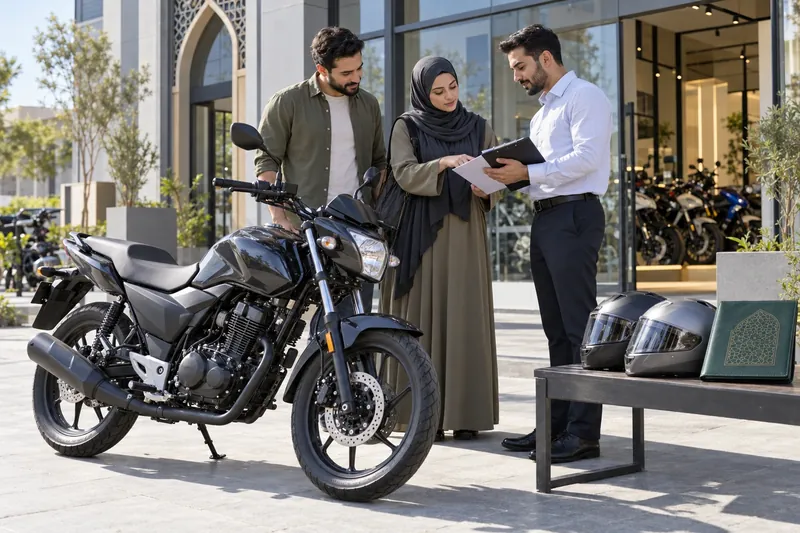
An islamic motorcycle loan is, in legal form, a purchase arrangement: the provider buys the bike and then sells or leases it to you, and you pay over time without any interest charge. For many riders, especially couriers, students and workers in cities where public transport is thin, a motorcycle is a tool for earning a living, which makes the choice of contract more than a theoretical exercise.
The label does not tell you whether the deal is fair or properly structured. Two offers may both be called halal while differing in ownership, insurance duties and what happens after a missed payment. The sections below walk through the contracts, the costs, the paperwork and the risks specific to two-wheeled vehicles, followed by routes that avoid finance altogether.
How an islamic motorcycle loan is structured
Two structures dominate vehicle finance. In a murabaha, the provider buys a specific motorcycle from a dealer and sells it to you at cost plus a disclosed profit, payable in instalments. Ownership passes to you at the time of sale, and the provider may take security over the bike until the price is paid.
In an ijara, the provider buys the bike and leases it to you for a term, and ownership transfers at the end by sale or gift under a separate undertaking. Because the provider is the owner during the lease, it carries certain duties, such as major maintenance and ownership risk, which classical rules expect it to bear.
Some providers use a diminishing musharaka, where you and the provider co-own the motorcycle and you buy out its share in steps while paying rent on the share you do not yet own. This is more common for property but can appear for higher-value vehicles.
Whatever the label, the contract should name the exact motorcycle, state the price and show when ownership changes.
Murabaha motorcycle finance step by step
Murabaha motorcycle finance usually follows a set sequence. You choose a bike and a dealer, and the provider checks your income and documents. If approved, the provider pays the dealer, takes ownership and then concludes the sale to you.
Watch for the order of events. Scholars generally expect the provider to hold the bike before selling it, even if only briefly, so the sale is of something it owns. Where the customer pays the dealer first and is reimbursed afterwards, the structure may be less sound, and a Sharia board's view should be sought.
Check what you receive in writing: the dealer invoice, the sale contract with the total price, the schedule of payments and the registration details. Your name should appear on registration papers where the law requires it, and the provider's security interest, if any, should be clear.
Ask for the price in two forms: the cash price at the dealer and the total deferred price you will pay. The difference is the cost of financing, and comparing it across providers is the simplest way to judge value.
Motorcycle financing costs and fees
Motorcycle financing costs show up in several places. Besides the profit built into the price, there may be documentation fees, registration costs, delivery and an insurance requirement. Compare offers on the total amount payable, not on the monthly figure alone.
A checklist to bring to each provider:
- Cash price and total deferred price
- Deposit required and whether it is refundable if the deal fails
- Number, size and dates of instalments
- Fees for documents, registration or early settlement
- Rules on late payment and where any late money goes
- Insurance or takaful required, and who pays
Deposits matter because motorcycles lose value. A larger deposit reduces the amount financed and the profit paid, and it may help in approval. Do not empty your savings, though, because you need a buffer for repairs and insurance.
If a provider pays a commission to a dealer, ask whether it affects your price. A clear answer is a good sign.
Takaful, insurance and the duty to protect the bike
Providers of an islamic motorcycle loan usually require cover on the financed vehicle. Islamic finance prefers takaful, a mutual arrangement in which participants contribute to a pool that pays claims, as an alternative to conventional insurance. Availability depends on the country, and in some places only conventional cover exists.
Check what the policy covers. Theft is a major risk for motorcycles, and some policies require approved locks, secure parking or a tracker. Cover may exclude young or new riders or specific use such as delivery work, which can void a claim.
Think about what happens after a total loss. If the bike is stolen and the payout is less than the balance owed, you may still owe the difference. Ask whether the contract provides for this, and consider cover that settles the balance.
Where a scholar has concerns about conventional insurance, they may allow it where takaful is not available, treating it as a need, but views vary. If this matters to you, seek a ruling before signing, not after.
Eligibility, documents and affordability for riders
Providers want proof of identity, address and income, often with a licence to ride. Newer riders and those with irregular earnings, such as gig-economy workers, may find it harder to qualify, though some providers consider bank statements over time.
Do an honest budget before applying for an islamic motorcycle loan. Include the instalment, fuel, insurance, tax or registration charges, servicing, tyres and parking. Many first-time buyers focus on the monthly payment and forget these running costs, which can add up substantially.
If the motorcycle is for work, estimate realistic income from it, and allow for slow periods, repairs and time off. A bike that cannot run earns nothing, while the instalment still falls due.
An islamic motorcycle loan, like any deferred-payment contract, creates a debt. Choose a payment that you could meet even if income fell for a while, and avoid stretching the term only to lower the monthly amount if that raises the total price.
Risks specific to two-wheeled vehicles
Every islamic motorcycle loan faces the same hazards, because motorcycles combine high theft rates, quick depreciation and accident risk. These shape the contract and your choices. Think about where the bike will be parked at night, what locks you will use and whether you have the skills and protective gear to ride safely.
Check what happens on default. Under many contracts a provider can repossess the vehicle and sell it. Ask how the sale proceeds are treated: if the sale brings less than you owe, are you liable for the difference, and if it brings more, do you receive the surplus? Fair terms return any surplus, and scholars generally expect that.
Beware of buying a bike beyond your skill. A powerful machine may be tempting but may also raise insurance costs and accident risk.
Finally, be sure about the dealer. Buy from a registered seller, inspect the bike and check its papers. A provider that finances a bike with unclear ownership puts you in a difficult position if a prior owner makes a claim.
Choosing a provider and reading the contract
Islamic banks and finance houses in many countries offer vehicle finance, and some include motorcycles, but availability varies. Look for a named Sharia supervisory board, a published list of approved contracts and a clear complaints process.
Read the contract before signing, preferably with someone you trust. Check the names of the parties, the description of the vehicle, the price, the schedule and the default terms. Ask about early settlement and whether a rebate applies, because Islamic scholars encourage lenders to reward early payment.
Avoid offers that ask you to sign blank forms, to pay a fee before approval or to hand over papers without a receipt. Do not accept verbal promises that differ from the document.
If you feel uncertain about an islamic motorcycle loan structure, ask a scholar who is not paid by the provider to review the contract. The cost of a consultation is small compared with a multi-year commitment.
Saving, community support and crowdfunding for a motorcycle
Not everyone needs finance. Buying a used motorcycle with savings avoids a contract altogether, and a modest bike may serve well for commuting or delivery work. Saving a deposit first also lowers the amount financed later.
Family and community can help. A relative may lend interest-free against a written agreement, and a mosque or community fund may assist with the cost of work tools in some cases. Charities that support livelihoods sometimes provide vehicles or small grants for people starting a trade, subject to their own criteria.
A crowdfunding appeal is another path. If a motorcycle will let someone reach work or training, supporters might give as sadaqah, or lend small amounts interest-free. The appeal should state the price, the quotation and the purpose, and the organiser should report once the bike is bought.
Whichever way you proceed, keep the paperwork, insure the bike and plan for upkeep, so the purchase serves its purpose without becoming a burden.
Organisations offering this service
- Bank Islam Malaysia – Superbike Financing-i — Murabahah-based financing covering up to 70% of the on-the-road price of new or recently reconditioned motorcycles, with tenures up to seven years.
- Meezan Bank – Apni Bike — Motorcycle financing under Musawamah, where the bank buys the bike and resells it to the customer for payment over time.
Related pages
- Islamic funding for personal needs: loans and campaigns
- Islamic Loan for Over Indebted Households: Support First
- Islamic Loan for Women: Business, Home and Family Needs
- Islamic Payday Loan: Sharia Limits and Halal Alternatives
- Islamic Reverse Mortgage: Structures and Sharia Questions
- Buy a Car Without Riba: Halal Car Finance Options
- Islamic Crowdfunding for Families Facing Hardship: Options