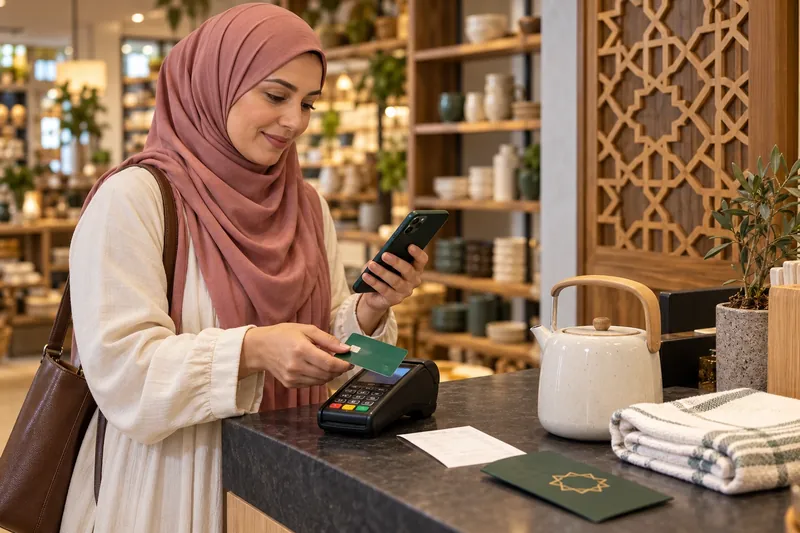
An Islamic credit card with no riba lets you pay for goods and services now and settle later, without the issuer charging interest on your unpaid balance. Because interest is the central feature of a conventional credit card, an Islamic version has to be built on another foundation, such as a fixed fee, a sale contract or a pay-in-full charge card.
The plastic and the contactless payment look the same. What changes is the contract behind it, the way late payment is handled and the way the issuer earns its income. The sections below explain these differences so that you can read a card's terms with confidence.
Why an Islamic credit card with no riba needs a different design
A standard credit card is a revolving loan. Each month you may repay a minimum, and the unpaid part attracts interest, which Islamic scholars treat as riba. Remove the interest and the issuer must still cover the cost of funding your spending, running the system and carrying the risk of non-payment.
Islamic issuers therefore use structures that earn income from services or sales rather than from lending money for a premium. The two broad approaches are a card on which you pay a fee for the service of having a payment facility, and a card where each balance carried forward is handled as a sale contract between you and the issuer.
- Fee-based: an annual or monthly charge for the facility, not linked to your balance.
- Sale-based: the issuer buys a commodity for you and sells it to you on deferred terms, with a profit amount agreed in advance.
- Charge card: the full balance is due each statement, so no financing arises at all.
Which approach a card uses is stated in its terms, and you should read that section before you apply.
Fees on a sharia-compliant credit card
Without interest, the fee schedule matters more. Common charges include an annual fee, a charge for cash withdrawals, a foreign transaction fee and sometimes a service fee per statement. These should be set out as fixed amounts or clearly defined rates, not as a hidden spread.
A well-run sharia-compliant credit card keeps the fee structure transparent. If the annual fee is high, check whether the benefits justify it. If the card offers a fee waiver after a certain amount of spending, remember that spending to qualify for a waiver can cost more than the fee itself.
Cash advances
Withdrawing cash on a card is often treated cautiously by scholars, because it can resemble a loan for a fee. Some issuers offer it through a separate permitted contract, others restrict or exclude it. Read the exact wording.
Currency conversion
Spending abroad can involve an exchange rate margin and a fee. Ask how the rate is set, since an unclear margin is a cost even when the contract is lawful.
Late payment and penalties on a halal payment card
Late payment is the area where Islamic and conventional cards diverge most sharply. A conventional issuer adds interest and often a late fee that becomes its income. In Islamic finance, a charge that grows because you are late is considered a form of riba, so issuers have developed alternatives.
One widely discussed approach is to allow a late-payment charge that is not kept as income but given to charity, often under the supervision of the Sharia board. The purpose is to discourage deliberate delay without letting the issuer profit from it. A genuine inability to pay is treated differently from carelessness, and some boards expect the issuer to be lenient in hardship cases.
- Find out whether a late charge exists and where it goes.
- Ask how the issuer treats a customer in real hardship.
- Check the effect of missed payments on your credit file.
Whatever the structure, a missed payment can still affect your credit record and your ability to borrow elsewhere. A halal payment card does not remove that obligation, so set up a reminder or an automated payment of the full balance.
Charge card versus financing: which islamic credit card with no riba suits you
A charge card requires the full balance every month. It fits people who use a card for convenience, rewards and record keeping, but who already have the cash. Because no deferred financing arises, the contract is simpler and the Sharia concerns are fewer.
A card with a financing element lets you spread payments, which can help in an emergency. It also invites overspending, since the facility feels like extra income. An Islamic credit card with no riba is not a licence to borrow without limit, and the profit you owe on a deferred sale is a real cost.
- Pay in full each month if you can, and treat the card as a payment tool.
- Use financing only for planned, short-term needs.
- Set a personal limit below the card limit.
- Review statements for anything unfamiliar.
If your income is unstable, a prepaid or debit card often removes temptation altogether. Many Islamic banks offer these as part of an ordinary account.
Rewards, cashback and Sharia questions
Cards often come with points, miles or cashback. These are usually funded by merchant fees, not by your interest, so they can remain acceptable. Scholars still raise a few points, such as rewards linked to prohibited merchants or insurance products bundled into the card.
Some Islamic issuers exclude spending at certain merchant categories from earning rewards. Others set a clear policy that the card cannot be used for prohibited purposes, such as gambling or alcohol, and may block them.
Bundled benefits
Travel insurance or purchase protection included with a card should be checked to see whether it is takaful-based or conventional. Ask the issuer, since the answer is not obvious from the marketing page.
Discounts and merchant offers
A discount at a restaurant is a trade benefit. Spending extra to earn a reward, however, can turn a small perk into a larger cost. The cleanest approach is to use the card for purchases you would make anyway.
Eligibility, limits and applying for an Islamic credit card with no riba
For an Islamic credit card with no riba, issuers still consider income, employment, existing obligations and credit history. Even with no interest, they must judge whether you can repay, so expect an affordability check. The limit you receive reflects that judgement, not your wish.
Residency rules vary. Some Islamic cards are only available to residents of the country where the issuer operates. Cards from Gulf banks, for example, may be tied to local salary accounts, while Malaysian and British providers may require a local address and identity documents.
- Gather identification, proof of income and proof of address.
- Read the product disclosure sheet and the Sharia contract summary.
- Apply for one card at a time, because many applications can affect your credit file.
- Activate the card and set alerts for each transaction.
If an application is declined, ask which factor was decisive. Often the reason is a thin credit history or high existing debt, and addressing that improves later chances.
Debt, hardship and alternatives to a card
Even an Islamic credit card with no riba can lead to debt when spending outpaces income. If you are struggling, contact the issuer early. Islamic institutions are expected to act with mercy toward those in genuine difficulty, and many have hardship teams that can agree a schedule.
In a Sharia context, deferring repayment without need is discouraged, and the Prophetic tradition praises giving time to a debtor. That principle shapes how responsible issuers treat arrears, but it does not erase the debt.
- Qard hasan from community funds or relatives costs nothing.
- A murabaha purchase plan can finance a specific item at a stated profit.
- A savings buffer avoids borrowing in the first place.
- Donation or reward crowdfunding can help with a charitable cause, though it is not a way to clear personal card debt.
Do not take on a second card to pay off the first. Free money advice services in your country can help you build a plan.
Questions to ask the issuer before you sign
Before you take an Islamic credit card with no riba, ask the provider the questions below in writing. A weak answer to any of them is a reason to look elsewhere.
- Which contract does the card use, and who approved it?
- What is the annual fee and what exactly does it cover?
- What happens, step by step, if I pay late?
- Where do late charges go?
- Can I pay the balance early without a penalty?
- How is my information shared with credit agencies?
- How do I close the account?
Keep a copy of the terms you accepted, because they can change. Issuers must usually notify you before material changes, and you can often close the account if you do not agree.
Finally, check that the card is issued by a licensed bank and that your deposits and card account are covered by the rules of your country. A qualified scholar can advise on any remaining doubt, and nothing above is financial or legal advice.
Organisations offering this service
- Emirates Islamic — UAE Shariah-compliant bank offering credit, debit and prepaid cards for personal and business customers.
- Alrajhi Bank Malaysia — Malaysian Shariah-compliant bank offering deposit accounts, financing, credit cards and digital banking.