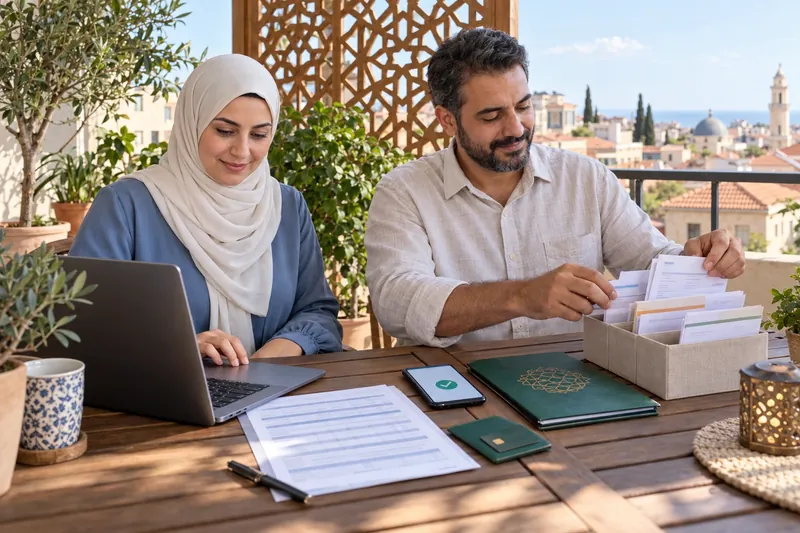
A bank account without riba is an account where no interest is paid to you, no interest is charged to you, and the bank's contract and activities are arranged to stay clear of riba throughout. That sounds simple, but a zero-interest balance alone does not settle the question. An account at a conventional bank that pays 0 percent still sits inside an institution that lends and borrows on interest, so the real test is the contract and the way the bank uses your money.
This matters to a customer who has checked the headline rate and wants to go further: what do the terms say, how are charges calculated, what happens when the balance dips, and which parts of the relationship could reintroduce interest? The sections below work through those checks one by one. A qualified scholar or the bank's Sharia supervisory board has the final word on what is acceptable, so use the checks to prepare good questions rather than to issue a ruling yourself.
Interest checks: where riba can hide in an ordinary account
Riba rarely appears under that name. Look at the statement and the terms for interest credited on balances, interest debited on an unauthorised overdraft, and charges that grow with the amount or the time you are in deficit. Each of these is a conventional feature.
Less obvious sources include tiered balance bonuses that are really interest paid in another form, linked savings products that pay a rate, and cards with revolving credit attached to the same login. A bank account without riba should keep these elements out of the contract, or at least allow you to decline them without penalty.
Penalty charges also deserve attention. A fixed fee for a returned payment may be defensible as a recovery of cost, while a percentage of the unpaid sum is closer to interest. If a fee rises with the size or duration of a problem, ask how the bank justifies it and where the money goes. Many Islamic institutions direct late-payment amounts to charity instead of recording them as income.
Noninterest bank accounts at Islamic banks and at conventional banks
Two types of provider offer accounts marketed as interest-free. A fully Islamic bank runs all of its business under Sharia supervision, so your balance is used inside an institution that avoids interest on both sides of the balance sheet. A conventional bank with an Islamic window or an Islamic product line runs a separate section for Sharia-compliant accounts while the rest of the bank continues on conventional terms.
Scholars generally prefer the first model because funds are less likely to be mixed with interest-based activity, but views on windows differ, and many windows operate with their own Sharia board and segregation of funds. Ask how segregation works: separate accounting, separate investment pools and a separate approval process for each product.
Also remember that some conventional banks offer basic accounts with no interest at all, simply because they pay nothing on small balances. That is a feature of the product, not a Sharia design. The bank may still lend the cash at interest, and there is no Sharia board reviewing the account. Treat it as a different category from a bank account without riba that comes with a documented Islamic contract.
The contract behind the account: wadiah, qard and mudarabah
The account terms should name the contract. Wadiah yad dhamanah means the bank keeps your money in trust, may use it and guarantees to return it in full. Qard means you lend the balance to the bank without a return and the bank repays the full amount on demand. Both are suitable for current accounts because the principal is protected.
Mudarabah and wakala apply to savings or investment accounts. In mudarabah you provide capital and the bank works as manager, sharing profit at a pre-agreed ratio; losses fall on the capital provider unless the manager was negligent. In wakala the bank acts as your agent for an investment and may earn a fee. Neither promises a fixed profit.
If you read the term sheet and find no contract named, or a name that does not match the way the account behaves, ask the provider to explain. A genuine contract produces consequences: who bears risk, what happens to profit and what the bank may do with the balance. Those consequences should be visible in the terms and not only in the marketing text.
A bank account without riba: a practical checklist
Before you open anything, write down the questions and keep the answers. The list below covers the points most customers need.
- Which contract governs this account, and where is it named in the terms?
- Who sits on the Sharia supervisory board, and does its approval cover this product?
- Is there any interest credited or debited anywhere on the account?
- How are fees for returned items, dormant accounts and unauthorised borrowing calculated?
- What happens to amounts collected as late-payment fees?
- Is the bank fully Islamic or does it run a window?
Ask for the answers by email so that you can show them to a scholar later. If a provider avoids a direct reply on one of these points, treat that as information. A bank with a settled Islamic process normally has a standard explanation ready.
Keep a copy of the version of the terms you accepted. Terms can change, and a later change in fees or profit calculation should come with an explanation and, ideally, a fresh Sharia approval.
Savings, profit and what is not guaranteed
Customers moving to a riba-free account often want to know what happens to the money they save. With profit-sharing savings, the bank invests and distributes profit according to the agreed ratio. The figure you see on a rate table is usually an expected or indicative profit, which may differ from what is actually paid.
That is a real difference from a conventional savings account, where the rate is contractual. It also means that two providers cannot be compared by rate alone. Look at how the bank invests, what share of profit goes to depositors, how fees are taken and whether a profit-smoothing reserve exists.
Where a bank states that deposits are protected by a national scheme, check whether that applies to the savings product and how profit-sharing deposits are treated. Protection rules differ by country and by product, so read the provider's own explanation. A bank account without riba is not risk-free just because it is Islamic, and no provider can promise a return without turning the structure into something else.
Wages, bills and cash flow when the account has no overdraft
Many people discover the difference in daily use. A riba-free account typically does not let you spend money you do not have, so a payment that exceeds the balance may be refused. That protects you from a hidden cost but calls for more careful planning.
Move direct debits to dates shortly after your salary arrives, set balance alerts in the app, and keep a small buffer in the current account. If you have irregular income, split money into a bills pot and a spending pot so that essential payments are covered first.
If you need short-term credit, ask your bank about a qard hasan facility, a small murabaha purchase or support from a community fund. These routes work within the same principle: no extra charge for time. For a longer project, such as building a business or a community venture, Islamic crowdfunding can sometimes supply capital without a loan, though it follows its own rules and does not replace an everyday account.
Opening the account: identity, residence and cross-border use
The application process follows normal banking law: identity, proof of address, tax residence and, where required, details about your income or the source of funds. Providers may ask about the countries you send money to, because of financial crime rules. Prepare documents before you apply.
If you live in one country and send money to another, check whether the account supports international transfers, which currencies are available and whether the bank charges a fixed fee or applies an exchange margin. For families who divide their year between two places, ask whether the account can be used from abroad and whether a local address is needed.
Some Islamic banks open accounts for non-Muslim customers, and several describe their services as open to customers of every belief. If you want a bank account without riba because of ethical preference, you can ask for the same terms. Read the complaints process, the contact route for the Sharia board and the closure terms before you commit, and keep copies of everything you sign.
Organisations offering this service
- Gatehouse Bank — UK bank offering Shariah-compliant savings accounts, Cash ISAs and Home Purchase Plans for retail customers.
- KT Bank AG — German bank that describes its products as interest-free and Islamic-compliant, with a free GiroKonto current account.